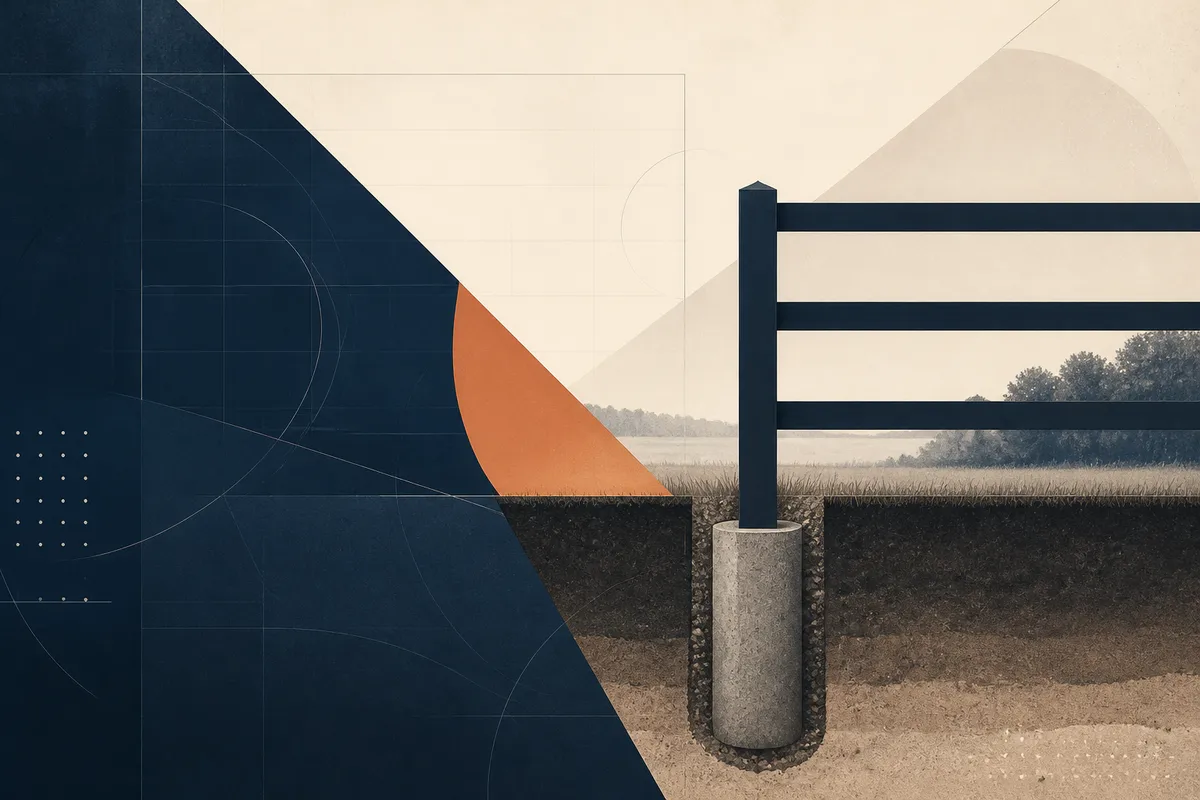
The Mechanics of Ground Shift: Engineering Stable Fence Footings in East Texas
East Texas soil is notoriously restless. In the Smith County area, the ground is a complex mosaic often dominated by the Tyler Series, which consists of very deep, somewhat poorly drained soils. When these soils encounter the heavy precipitation often recorded at Tyler Pounds Field, they swell; during the inevitable summer droughts, they shrink and crack. If a fence post is simply dropped into a shallow hole with a bag of concrete, these cycles turn the footing into a piston, slowly pumping the post upward until the fence leans or collapses.
Achieving long-term stability requires more than just more concrete; it requires managing soil friction and displacement. This guide breaks down the physics of why fences sink or heave in regional clays and sandy loams, and how to engineer a footing that stays put regardless of the weather.
Why Standard Fence Footings Fail in Heavy Clay
In most stable environments, a fence post stays upright through simple displacement. In the reactive soils of East Texas, however, the soil acts as a dynamic force rather than a static anchor.
- High-clay content soils expand significantly in volume when wet, which creates high "skin friction" against the sides of a concrete footing (mtefence.com).
- As the soil dries and shrinks, it pulls away from the footing, allowing debris or water to fill the gap and reset the anchor point higher during the next expansion cycle.
- Shallow footings that do not reach the consistent moisture level of the subsoil are subject to the most violent movements of the "active zone."
- Top-heavy concrete "plugs" that are wider at the top than the bottom are easily gripped by expanding soil and pushed toward the surface—a process known as heaving fence posts (johnsonservicescompany.com).
The Playbook for Deep-Soil Post Anchoring
1Optimize the Fence Post Footing Depth for Clay Soil
Standard 24-inch depths may be sufficient for some standard fences (k2fence.com), but tall solid fences in soft clay require deep, wide footings (johnsonservicescompany.com). For a six-foot-high finished post, burying the post three feet into the ground is recommended (facebook.com). This depth provides the necessary leverage to resist wind loads against the sail area of a wood privacy fence.
2Utilize the Bell-Bottom Technique
Instead of a uniform cylinder, the hole should be flared at the base, creating a "bell" shape. This creates a mechanical lock where the wider base of the concrete is held down by the weight of the soil above it. It prevents the "wedge effect" that causes posts to pop out during saturated winters.
3Manage Soil Friction with Smooth Formwork
In extremely aggressive clay, using a smooth-walled tube or liner for the top 12 inches of the footing can be beneficial. This reduces the ability of the topsoil to "grab" the concrete. The friction is then concentrated at the deeper, more stable levels of the earth where movement is minimized.
4Account for Sandy Loam Drainage
In areas where the clay transitions into sandy loam, the challenge shifts from heaving to sinking. Sandy soils lack the cohesive strength of clay. In these zones, the footing must be wider to distribute the vertical load of the fence over a larger surface area, preventing the post from "drilling" into the ground over time.
The Physics of Soil Friction and Uplift
The primary enemy of a fence in East Texas is the "uplift" force. When clay expands, it doesn't just move sideways; it moves toward the path of least resistance, which is up. If the texture of the concrete footing is rough and the shape is cylindrical, the soil bonds to the concrete and pulls it upward.
The shear stress exerted by the soil against the surface of the buried footing, which determines how much force the soil can transfer to the post.
By engineering the footing to be "bottom-heavy," the weight of the earth itself acts as a counter-ballast. A bell-shaped footing effectively turns the surrounding soil into an anchor rather than a lever. This is especially critical for gate posts, which must withstand both the vertical weight of the gate and the lateral pull of the tensioned wire or wood panels.
Engineering a Durable Scope of Work
When planning a project in the Tyler service area, a sound scope of work should prioritize sub-surface specifications over aesthetics. Homeowners should expect a detailed plan for hole depth, diameters, and the specific PSI of the concrete mix used. A professional approach involves surveying the property for drainage patterns, as standing water will accelerate soil softening and post-destabilization (i30builders.com). For those managing large acreages or residential lots, having a clear understanding of the soil profile—whether it is the silty alluvium of the Tyler series or a more stable loess—is the first step toward a fence with a significantly extended lifespan. For specific site evaluations, contacting a professional at (903) 560-4422 can provide clarity on regional soil behavior.
Frequently asked questions
How deep should fence posts be in East Texas?
Following the 1/3 rule, a six-foot fence post should be buried 36 inches deep, while an eight-foot fence would require a depth of 48 inches in clay soil (facebook.com). Using a hole depth of 38 inches for an 8-foot post is also a common contractor standard (nmifence.com).
Why is my fence leaning even though the wood isn't rotten?
Leaning is usually a sign of "footing failure," where the soil has shifted, the holes were too shallow for the clay, or water is pooling at the posts (i30builders.com). In East Texas, this often happens after a wet winter followed by a hot, dry summer.
Does concrete actually rot wood posts faster in clay?
If the concrete forms a "cup" that holds water against the wood, it can accelerate rot. Proper footings should be crowned at the top to shed water away from the post (nmifence.com) and extend deep enough that the base of the post is encased to prevent water from pooling.
Can I use gravel instead of concrete for fence posts in clay?
Gravel allows water to drain away from the post base, which can extend the life of wood posts (nmifence.com). However, in expansive clay, concrete footings are often required to provide the weight and shape needed to anchor the post against vertical heave.
How does sandy loam affect fence stability differently than clay?
Sandy loam drains better but has lower "bearing capacity," meaning it is easier for a heavy post to sink over time. Footings in sandy soil often need to be wider at the base to spread the weight out, whereas footings in clay need to be deeper to fight expansion forces.
What is the best time of year to install a fence in Tyler?
While installation happens year-round, the soil is easiest to work with when it has moderate moisture. Extremely dry summer conditions can make the clay as hard as rock, while excessively wet winters can lead to "slumping" in the post holes during the pour.
What happens when you get in touch: you describe the situation, we ask the few questions that actually change the answer, and you get a clear scope and next step — no obligation.