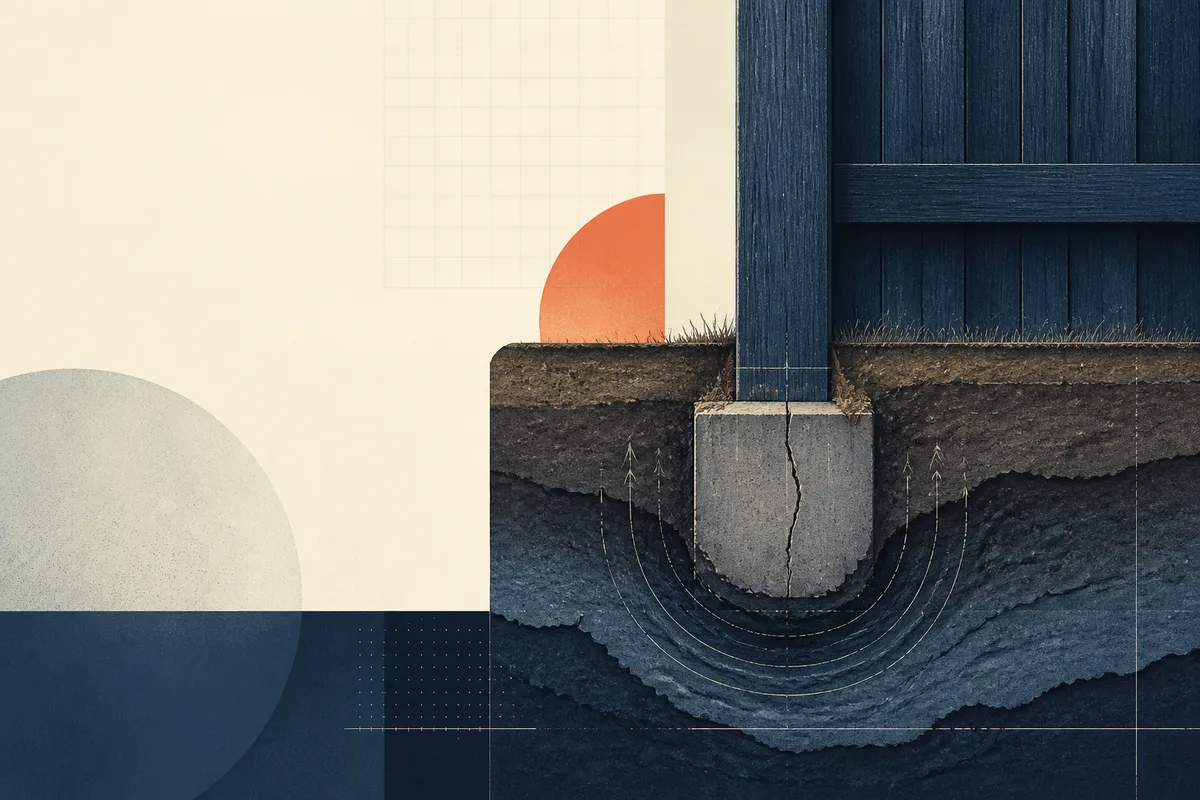
The Physics of Post Heave: Why Shallow Footings Fail in East Texas Clay
Most leaning fences in East Texas are not the result of high winds or rot; they are the result of hydraulic pressure. When the region's reactive clay saturates, it expands with enough force to lift entire concrete footings out of the earth, a process known as frost heave's warmer cousin: soil heave.
This guide breaks down the mechanics of soil expansion and the structural requirements for Tyler Service Area property owners who want a fence built to resist the specific soil challenges of the region. It identifies why standard "dig-and-pour" methods fail in high-PI (Plasticity Index) clays and how to counteract those forces. For more information on durable materials, see our page on Wood Privacy Fences.
Why Shallow Footings Fail in Reactive Clay
The Geologic Atlas of Texas, Tyler sheet reveals a complex surface geology involving clay-rich formations that are highly sensitive to moisture. When these soils encounter the frequent rain cycles common to the area, they undergo significant volume changes. Freezing and thawing soil can also lift posts directly out of the ground due to the formation of ice lenses (facebook.com).
- Uniformly smooth concrete cylinders provide no mechanical "grip" to resist the upward friction of expanding clay.
- A shallow post leaves more of its embedded length within actively freezing or saturating soil, increasing the risk of failure (nextdayfences.com).
- Inadequate drainage around the post base allows water to pool, accelerating the expansion of the surrounding clay.
- Top-heavy fence designs, such as board-on-board styles, exert leverage that a shallow footing cannot counteract once the soil softens.
The Playbook for Preventing Fence Post Heaving
1Identify Soil Plasticity
Before digging, an operator must understand the soil's behavior. High-plasticity clays require different depths than sandy loams found in other sections of the Soil Survey of Tyler County, Texas. Clay does not guarantee heaving, but it increases the risk when moisture is trapped (nextdayfences.com).
2Extend Beyond the Active Zone
The "active zone" is the depth to which soil moisture fluctuates significantly throughout the year. Tamping soil back around a post that is sitting on a shallow footing merely delays the next heave by a season rather than preventing it (countrylivingfence.com). Deep footings are necessary to reach soil with consistent moisture content.
3Employ the Bell-Hole Technique
Instead of a straight vertical shaft, the bottom of the hole should be flared out to be wider than the top. Without a wider footing at the base, improper concrete footings often fail to resist upward movement (nprfence.com). This "bell" acts as a mechanical anchor.
4Manage the Concrete Surface
The top of the concrete footing should be finished with a slight taper or "dome" above the grade. It is also critical to clear soil, mulch, and debris away from the post base, as trapped organic material holds moisture against the structure (mountainfence anddeck.com).
A numerical measure of the range of moisture content over which a soil behaves plastically; higher numbers indicate more "reactive" clay that will expand significantly when wet.
The Mechanics of the Bell-Shaped Footing
In a standard cylindrical hole, the soil exerts "skin friction" against the sides of the concrete. As the clay expands, this friction pulls the concrete upward. Because the concrete is a rigid, smooth mass, it slides up like a piston. Once it moves up, loose soil often falls into the gap underneath, preventing the post from ever settling back to its original depth.
A bell-shaped footing changes the physics of the assembly. By widening the base, the upward force of the soil expansion must now physically lift the weight of the soil column sitting on top of the bell. This design provides structural resistance against the upward movement associated with the heavy rain cycles recorded in the 7-Day Forecast for Tyler.
How Fence Tyler Helps
Addressing reactive soil issues starts with a site evaluation to determine the specific soil composition and slope. For a durable installation, a scope of work should specify the depth of the post holes and the use of widened footings to prevent heave (youtube.com). Proper placement is also a logistical requirement; all fence structures and their footings must remain entirely within the property line. Property owners can call (903) 560-4422 to discuss local ground conditions or request a formal assessment through the online portal.
Frequently asked questions
How deep should fence posts be in East Texas clay?
Posts must be set deep enough to anchor below the active moisture zone. Shallow footings are a primary cause of failure because they leave the post embedded in soil that is actively freezing or saturating (nextdayfences.com).
Can I just add more concrete to stop a post from leaning?
Adding a larger "collar" of concrete near the surface often makes the problem worse. This creates more surface area for the expanding clay to grab, effectively giving the soil a larger handle to lift the post out of the ground.
Does fence post heaving happen in the summer?
Heaving typically occurs during the transition from dry to wet seasons when the clay absorbs water and expands. However, the damage is often most visible in the summer when the clay dries out and shrinks, leaving the now-misaligned post loose in a widened hole.
Are certain fence styles more prone to heaving?
Heavy, solid-surface fences like board-on-board or tall privacy fences are more susceptible because they act as sails in the wind. The lateral force of the wind works in tandem with the vertical force of the soil to destabilize the footing.
Do metal posts prevent heaving better than wood?
The post material itself does not change the soil mechanics, but metal posts are thinner and create less displacement. However, the stability still relies entirely on the depth and shape of the concrete footing surrounding the post.
Is a permit required for fencing?
Local regulations typically require that the entire fence structure, including the underground concrete footings, stay within the property boundaries. Property owners should consult their local municipal building department to ensure compliance with specific setback rules and permit requirements.
What happens when you get in touch: you describe the situation, we ask the few questions that actually change the answer, and you get a clear scope and next step — no obligation.